Affiliate Disclosure: Corea Skincare participates in various affiliate marketing programs, which means we may earn commissions on purchases made through our links to retailer sites. As an Amazon Associate, we earn from qualifying purchases. These commissions help us maintain our site and continue providing valuable content to our readers at no additional cost to you. We only recommend products we believe will benefit our community.
Here's something that's been bugging me: every K-beauty blog (including ours, honestly) writes "best-seller" lists based on vibes. Someone uses a product, likes it, and declares it a best-seller. But what's actually selling? Which Korean skincare brands are genuinely dominating — and where?
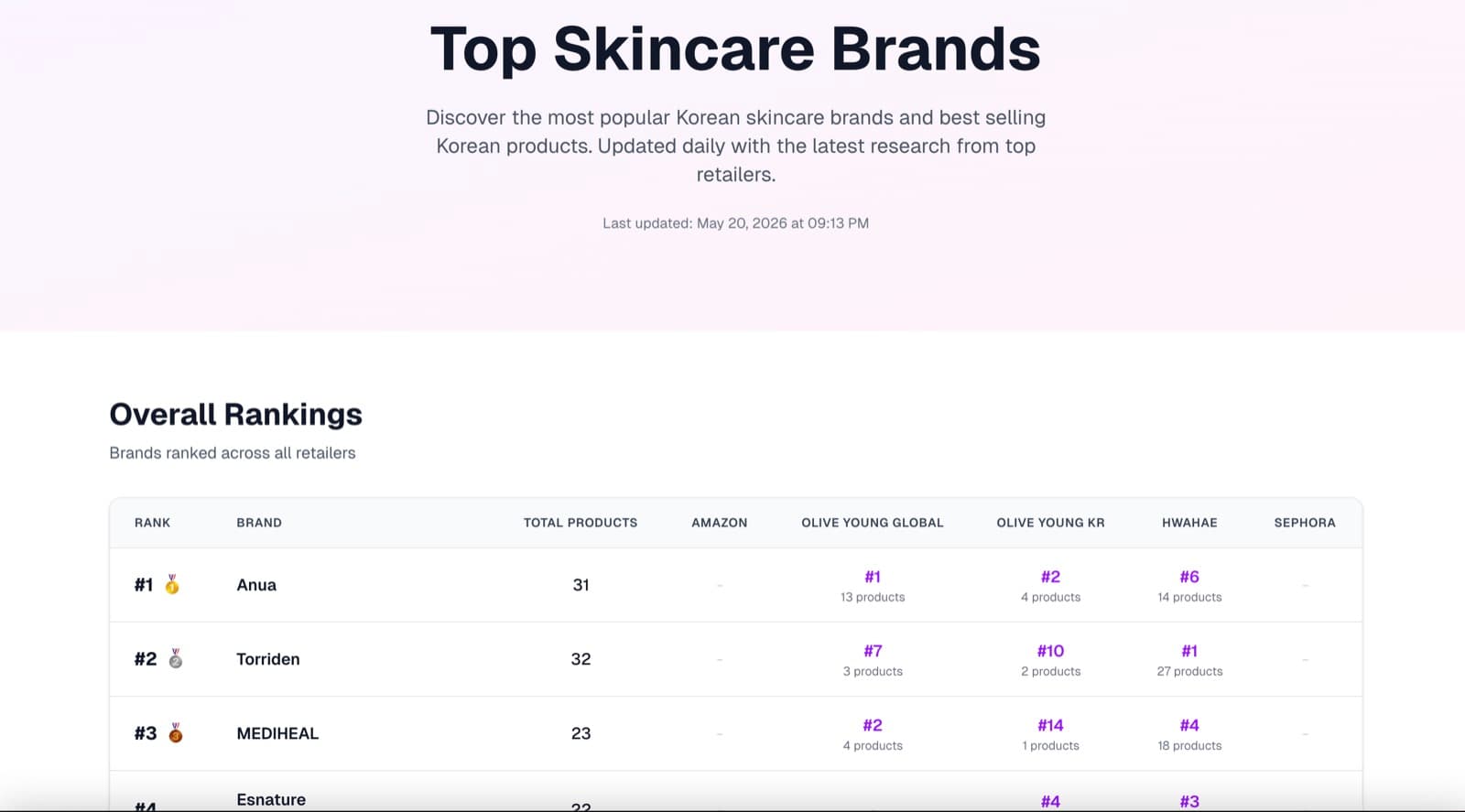
So we built something. Since late 2025, we've been crawling five major beauty retailers every single day — Amazon US, Olive Young Global, Olive Young Korea, Hwahae (Korea's biggest beauty review app), and Sephora — and recording what's on their best-seller lists. Product names, brand positions, prices, ranking scores. Every day. Automatically.
Medical Disclaimer: The information provided in this article is for educational and informational purposes only and is not intended as medical advice. Everyone's skin is unique, and what works for one person may not work for another. If you have specific skin concerns, underlying health conditions, or are experiencing persistent skin issues, please consult with a licensed dermatologist or healthcare professional before starting any new skincare routine. This content does not constitute a diagnosis or treatment recommendation.
After months of data, we have a clearer picture than any single "top 10" list could give you. And the results are genuinely surprising — especially if you think K-beauty is the same everywhere.
You can see the live rankings yourself at our Top Brands page, which updates daily. But today, we're going deeper into what the data actually means.
The Setup: What We Track and How
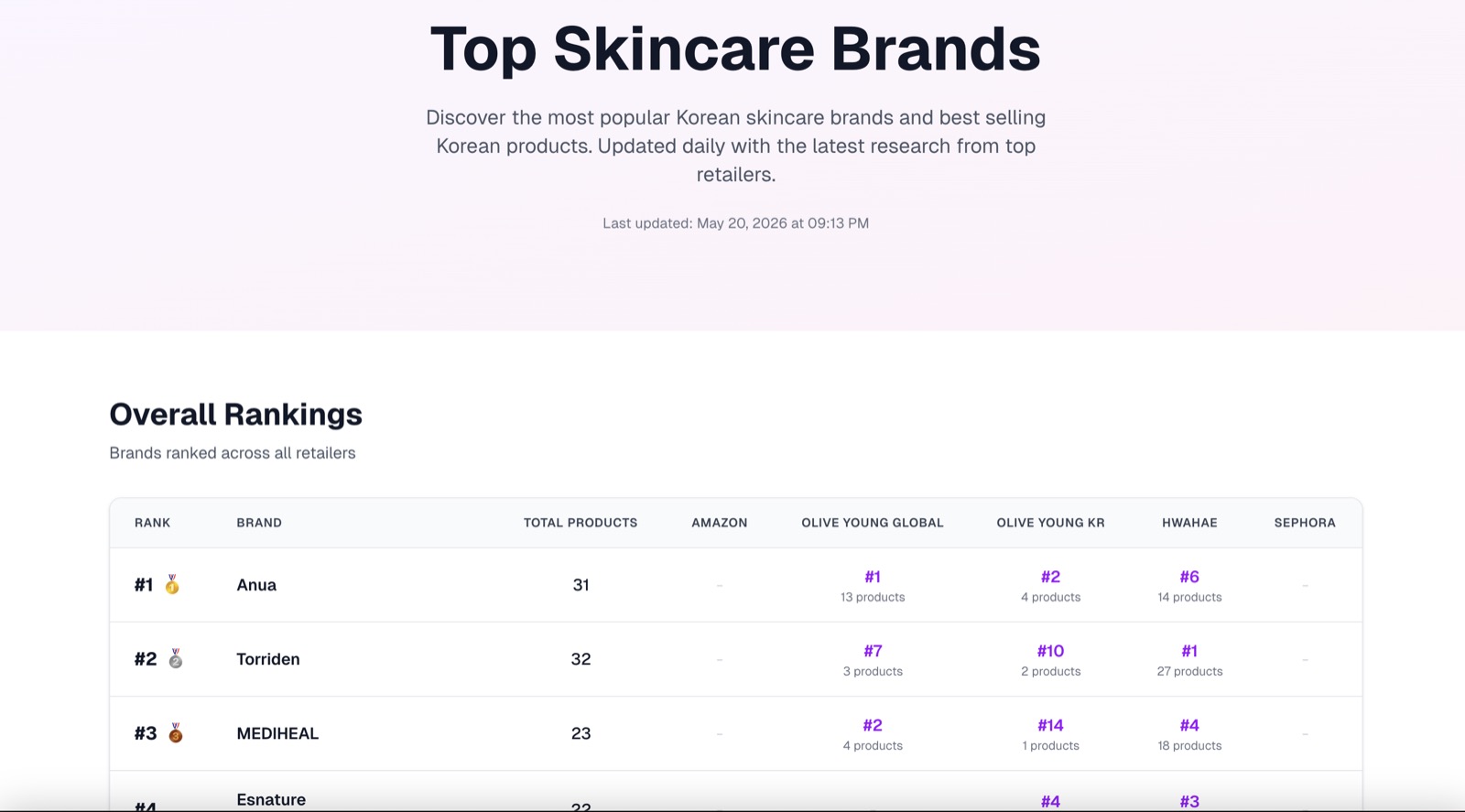
Every day, our system pulls the current best-seller rankings from five sources:
Amazon US — The "Beauty & Personal Care" best-seller list. This is the biggest beauty marketplace in America, and it's not exclusively K-beauty. Western brands, drugstore brands, and Korean brands all compete on the same list. That's what makes it interesting — when a Korean brand cracks Amazon's top 10, it's competing against Neutrogena, Garnier, and CeraVe. Not a K-beauty echo chamber.
Olive Young Global — The international-facing version of Korea's dominant beauty retailer. This is where K-beauty fans outside Korea shop. The audience is mostly international consumers who specifically seek out Korean products. Think of it as the K-beauty-dedicated marketplace.
Olive Young Korea — The domestic Korean version. What actual Koreans are buying in their own market. This is the closest thing to "ground truth" for what's popular in Korea, not just what's marketed as Korean abroad.
Hwahae — Korea's largest beauty review and ranking platform. Think of it as the Korean equivalent of Beautypedia crossed with Yelp. Koreans use it to check ingredient safety ratings and real user reviews before buying. A brand charting on Hwahae means it has genuine consumer trust in Korea.
Sephora — The Western premium beauty retailer. When K-beauty brands break into Sephora's rankings, they've crossed over into mainstream Western retail — not just the K-beauty niche.
We track about 171 brands and 238 products across these five sources on any given day. Each product gets a position rank and a normalized score so we can compare across platforms. We then compute a unified ranking that weighs average position (40%), product count (35%), and retailer presence (25%) to determine the overall top brands.
Here's what we found.
Finding #1: Almost No Brand Dominates Everywhere
This is the headline finding, and it genuinely surprised us.
Out of 171 brands tracked across five retailers, the vast majority exist in only one or two marketplaces. When we compute our unified ranking — weighing position, product count, and retailer presence — the brands that appear across the most platforms rise to the top. Here are the current overall leaders:
| Unified Rank | Brand | Total Products | Platforms Present |
|---|---|---|---|
| #1 | Anua | 31 | OY Global (#1), OY Korea (#2), Hwahae (#6) |
| #2 | Torriden | 32 | OY Global (#7), OY Korea (#10), Hwahae (#1) |
| #3 | MEDIHEAL | 23 | OY Global (#2), OY Korea (#14), Hwahae (#4) |
| #4 | Esnature | 23 | OY Korea (#4), Hwahae (#3) |
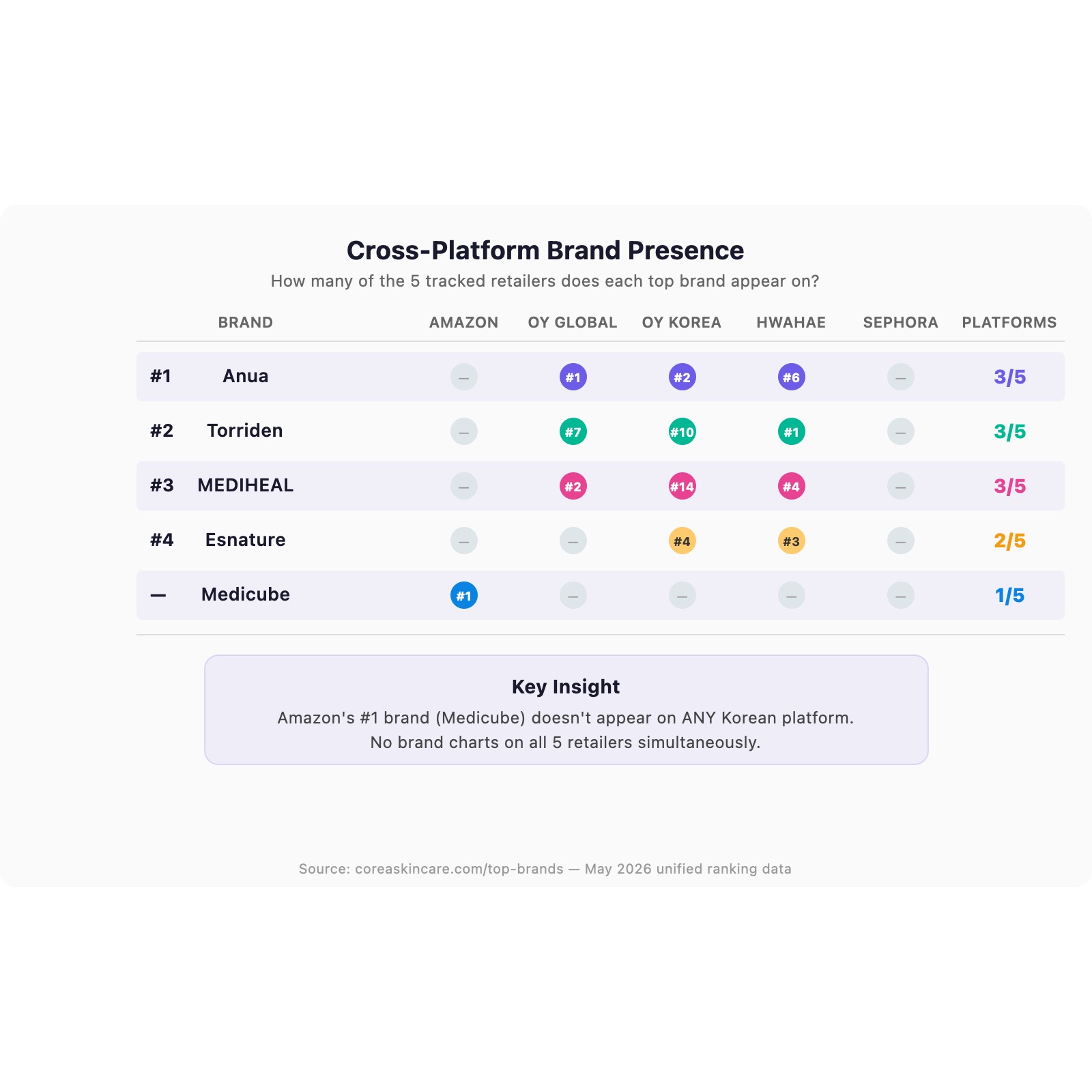
Notice something? No brand charts on all five platforms. The top-ranked brand in the world, Anua, appears on three out of five. Most brands — including Amazon's #1 Medicube — dominate one platform and are invisible on the others.
The brands that rank highest in our unified system aren't necessarily the ones with the best position on any single platform. They're the ones with consistent presence across multiple markets. Anua isn't #1 on any individual platform (Hwahae's #1 is Torriden, OY Global's top product position goes to Round Lab), but Anua shows up everywhere — 31 products spread across three retailers. That consistency is what puts them on top.
What this means for you: If you only shop on Amazon, you're seeing a completely different K-beauty landscape than someone shopping on Olive Young Global, which is itself completely different from what's actually popular in Korea. There is no "universally best-selling" K-beauty brand. There are marketplace-specific winners — and the brands with real cross-platform staying power are a very short list.
Finding #2: The #1 Brand Is Different Everywhere
Each platform has a clear dominant player, and they have almost nothing in common:
Amazon #1: Medicube — Their Zero Pore Pads 2.0 have held the top position on Amazon's beauty best-sellers for months. This is remarkable because Amazon's list isn't K-beauty-specific — Medicube is outselling Neutrogena, Garnier, and every other Western drugstore giant. If you haven't tried them, we did a detailed review of the Medicube Zero Pore Pads. The $18.90 price point hits a sweet spot that Western consumers love.
Olive Young Global #1: Round Lab — Their Birch Juice Moisturizing Sunscreen dominates the international K-beauty market. Round Lab is practically unknown on Amazon but absolutely massive among dedicated K-beauty shoppers. Their sunscreen triple set ($52) has been a consistent top seller.
Olive Young Korea #1: Round Lab — Round Lab also dominates domestically, which validates their position. But the products that sell differ — Korean consumers buy different Round Lab items than international consumers do.
The outlier: Medicube's Amazon dominance is wild. They've essentially done what no other Korean brand has managed — they've broken out of the "K-beauty niche" and compete directly with Western mass-market brands. On Amazon's overall beauty best-seller list, they regularly sit above Paula's Choice, Dove, and even Amazon Basics skincare.
Finding #3: Korea Shops Differently Than Everyone Else
The gap between what sells in Korea vs. what sells internationally is massive. Here's what the domestic Korean top sellers look like compared to the global market:
Korea-only brands that don't crack international lists:
- ZEROID (Position #10 in Korea — virtually unknown abroad)
- Esnature/에스네이처 (Position #7 in Korea)
- Purito (Position #25 in Korea — has some international presence but doesn't chart on our tracked platforms)
International-only brands that Koreans don't buy:
- SKIN1004 (#4 on OY Global, absent in Korea)
- Beauty of Joseon (huge internationally, doesn't chart domestically)
- COSRX (charts at #29 in Korea but is a megabrand internationally)
This pattern is consistent across our data: brands that Korean consumers actually use and brands that international K-beauty fans buy are largely two different lists. The "K-beauty" market abroad is almost a separate industry from the Korean domestic beauty market.
Why this happens: Korean consumers have access to hundreds of brands at every Olive Young, pharmacy, and convenience store. They discover products through Korean media, dermatologist recommendations, and Korean beauty communities. International K-beauty consumers discover products through English-language YouTube, Reddit's r/AsianBeauty, and TikTok. These are fundamentally different discovery channels that surface different brands.
Finding #4: PDRN Is the Hottest Ingredient Right Now
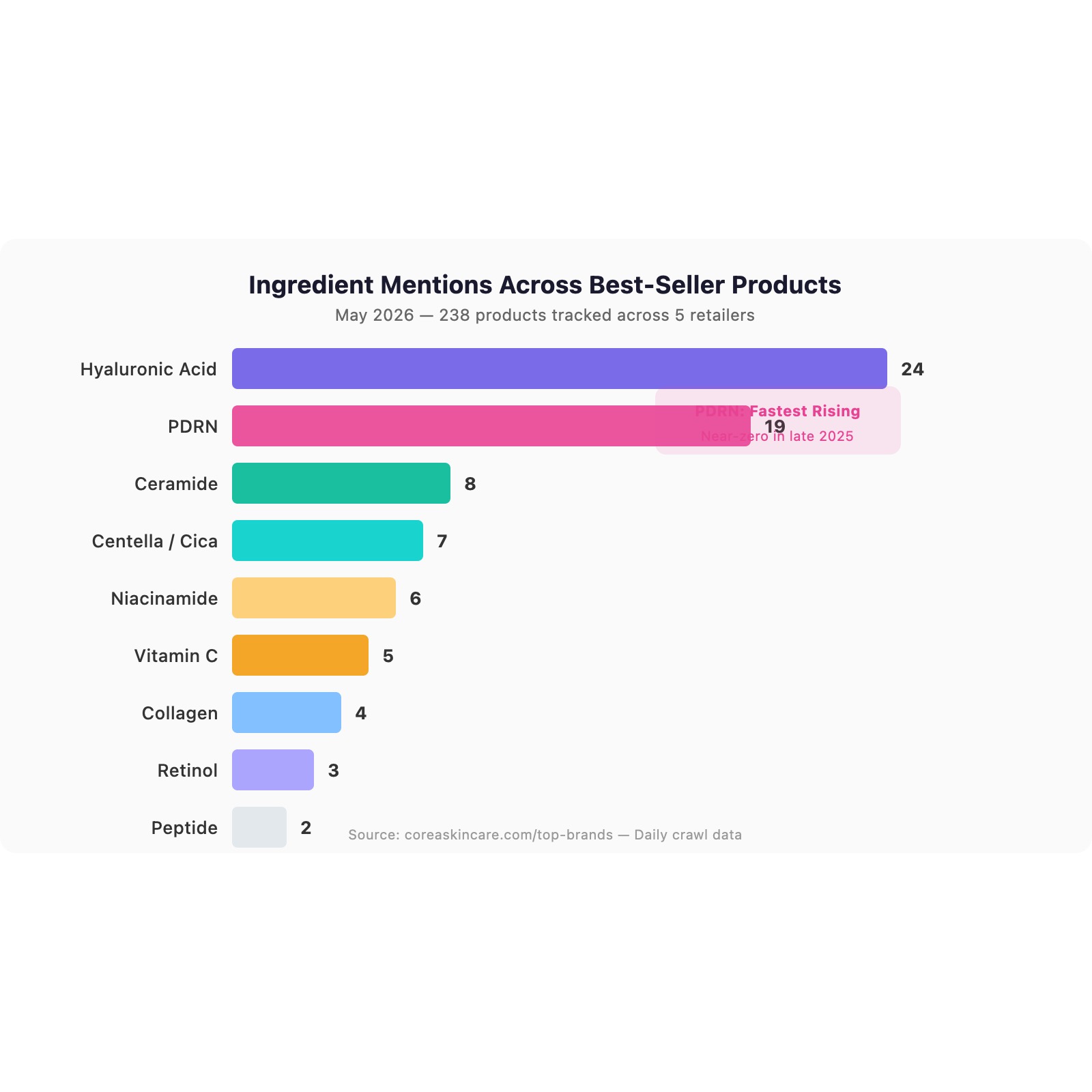
We tracked ingredient keywords across all 238 product names in our database. Here's what's trending:
| Ingredient | Product Mentions | Trend |
|---|---|---|
| Hyaluronic Acid | 24 | Steady dominant |
| PDRN | 19 | Rising fast |
| Ceramide | 8 | Stable |
| Centella/Cica | 7 | Stable |
| Niacinamide | 6 | Declining from peak |
| Vitamin C | 5 | Stable |
| Collagen | 4 | Stable |
| Retinol | 3 | Low but present |
| Peptide | 2 | Emerging |
Hyaluronic acid is still king — it appears in more best-selling products than any other ingredient. But the real story is PDRN (Polydeoxyribonucleotide), which has exploded from near-zero mentions in late 2025 to 19 product mentions in May 2026.
PDRN is a DNA fragment derived from salmon that promotes cell regeneration and wound healing. It was originally used in Korean dermatology clinics as an injectable treatment. Now it's showing up in serums, ampoules, and even toner pads across every platform we track.
Anua's PDRN Hyaluronic Capsule 100 Serum is one of the top-selling products on Olive Young Global (#2 position), and they've even released a PDRN 4-Step Glowy Skin Set ($123.57) that sits at position #7. When a brand creates a $124 set around a single ingredient and it charts, that ingredient has arrived.
We wrote a deep dive into the best PDRN products if you want to understand the science and find the right one for your skin.
What's declining: Niacinamide. It's still in products, but it's no longer the main selling point. Two years ago, niacinamide was the star ingredient on every label. Now it's relegated to supporting cast. Snail mucin, propolis, mugwort, and galactomyces — all once-hyped K-beauty ingredients — appear in zero current best-sellers.
Finding #5: Price Tells a Story
The pricing across platforms reveals something interesting about who's buying what:
Amazon average price point: $15-20 per product. Amazon shoppers want individual products at accessible prices. The best-sellers are mostly single items — one jar, one tube, one pack of pads. Value matters.
Olive Young Global average: $28-52 per product. International K-beauty shoppers buy bundles and sets. The top sellers on OY Global are frequently "Triple Sets" or "Duo Packs" — consumers are buying in bulk because they've already committed to the brand and want to save on shipping.
Olive Young Korea average: $17-23 per product. Korean consumers buy individual products at what are essentially "local" prices — lower than what international shoppers pay even on the Korean platform.
The price gap between what Koreans pay and what international consumers pay for the same products ranges from 20-40%. Part of this is shipping and platform markup, but it also reflects willingness to pay. International K-beauty consumers perceive these products as premium and accept higher prices. Korean consumers see them as everyday drugstore products.
Finding #6: Sunscreen Season Is Real (And the Data Proves It)
Round Lab's Birch Juice Sunscreen holding the #1 position on both Olive Young platforms in May isn't a coincidence. Our data shows a clear seasonal pattern: sunscreen products climb the rankings starting in April and dominate through August.
In the current May 2026 snapshot, sunscreen or SPF-containing products hold 3 of the top 10 positions on Olive Young Global and 2 of the top 10 on Olive Young Korea. SKIN1004's Madagascar Centella Water-Fit Sun Serum Twin Pack (#4 on OY Global) is another example — it's a sunscreen-forward product that peaks in warm months.
This matches what we've written about in our Korean sunscreen guide — Korean sunscreens are genuinely different from Western formulas, and the data shows consumers agree.
For shoppers: If you want the best deals on sunscreen, buy in February-March before the seasonal demand spike pushes popular products to the top of the charts (and sometimes out of stock).
Finding #7: The "K-Beauty Brands" Americans Know Aren't What Korea Buys
Here's the most sobering finding for K-beauty enthusiasts who think they know the market:
The brands that dominate English-language K-beauty discourse — COSRX, Beauty of Joseon, SKIN1004, Torriden — are not the brands that dominate in Korea. They're export brands. They exist primarily to serve the international market.
Meanwhile, brands that actual Korean consumers buy daily — ZEROID, Esnature, Labo-H, Centellian24 — barely register in English-language beauty media.
This doesn't mean the export brands are bad. COSRX makes excellent products. Beauty of Joseon's sunscreen is genuinely great (we reviewed it). But calling them "what Koreans use" is misleading. They're what Koreans export.
The true overlap — brands that both Koreans and international consumers actively buy — is strikingly small: Anua, Torriden, AESTURA, MEDIHEAL, and arguably Round Lab (which charts internationally but at different product levels than domestically).
If you want to know what Korean dermatologists actually recommend to Korean patients, look at AESTURA's AtoBarrier365 line (we reviewed it) and ZEROID's Soothing Cream — both top sellers domestically, both virtually unknown in the West.
What This Means for You
If you're a K-beauty consumer, here's the practical takeaway from all this data:
1. Don't trust any single "best of" list. The best-sellers on Amazon, Olive Young Global, and Olive Young Korea are almost entirely different products. A product being #1 on Amazon tells you it's popular with American consumers. It tells you nothing about what's popular in Korea.
2. If you want "authentic" Korean skincare, look at the domestic data. The Olive Young Korea rankings are the closest thing to what Korean consumers actually buy. Brands like ZEROID, Esnature, and AESTURA are the unglamorous workhorses of Korean skincare — boring packaging, excellent formulas, recommended by dermatologists.
3. PDRN is not a fad. With 19 product mentions across platforms and climbing, PDRN has moved from trend to mainstream. If you haven't tried it yet, Anua's PDRN serum is the easiest entry point (it's literally the #2 product on Olive Young Global right now).
4. The price you pay depends on where you shop. The same brand's products can cost 20-40% more on international platforms than on the Korean domestic market. If you're committed to K-beauty, learning to shop on Korean platforms (even with shipping) can save significant money over time.
5. Seasonal timing matters. Sunscreen dominates spring/summer rankings. If you plan ahead and buy your summer sunscreen in winter, you'll have better availability and sometimes better prices.
How We'll Keep Tracking This
We update our Top Brands page daily with fresh data from all five sources. You can check it anytime to see what's currently charting.
Going forward, we're planning to add more analysis:
- 6-month trend reports showing which brands are rising and falling
- New ingredient tracking so you can see when the next PDRN-like trend emerges
- Price tracking to help you find the best deals across platforms
If you have questions about specific brands or want us to dig deeper into any of these findings, let us know. The data is there — we just need to know what you want to see.
Want to explore the live rankings yourself? Check out our Top Brands page for daily-updated best-seller data across Amazon, Olive Young Global, Olive Young Korea, Hwahae, and Sephora. For product recommendations based on your specific skin type, take our personalized skincare quiz.
Product prices and availability are accurate as of the date/time indicated and are subject to change. Any price and availability information displayed on Amazon at the time of purchase will apply to the purchase of this product.
Medical disclaimer. This article is for educational purposes and is not medical advice. Everyone’s skin is different, and what works for one person may not work for another. If you have persistent or painful skin concerns, please see a licensed dermatologist or healthcare professional.