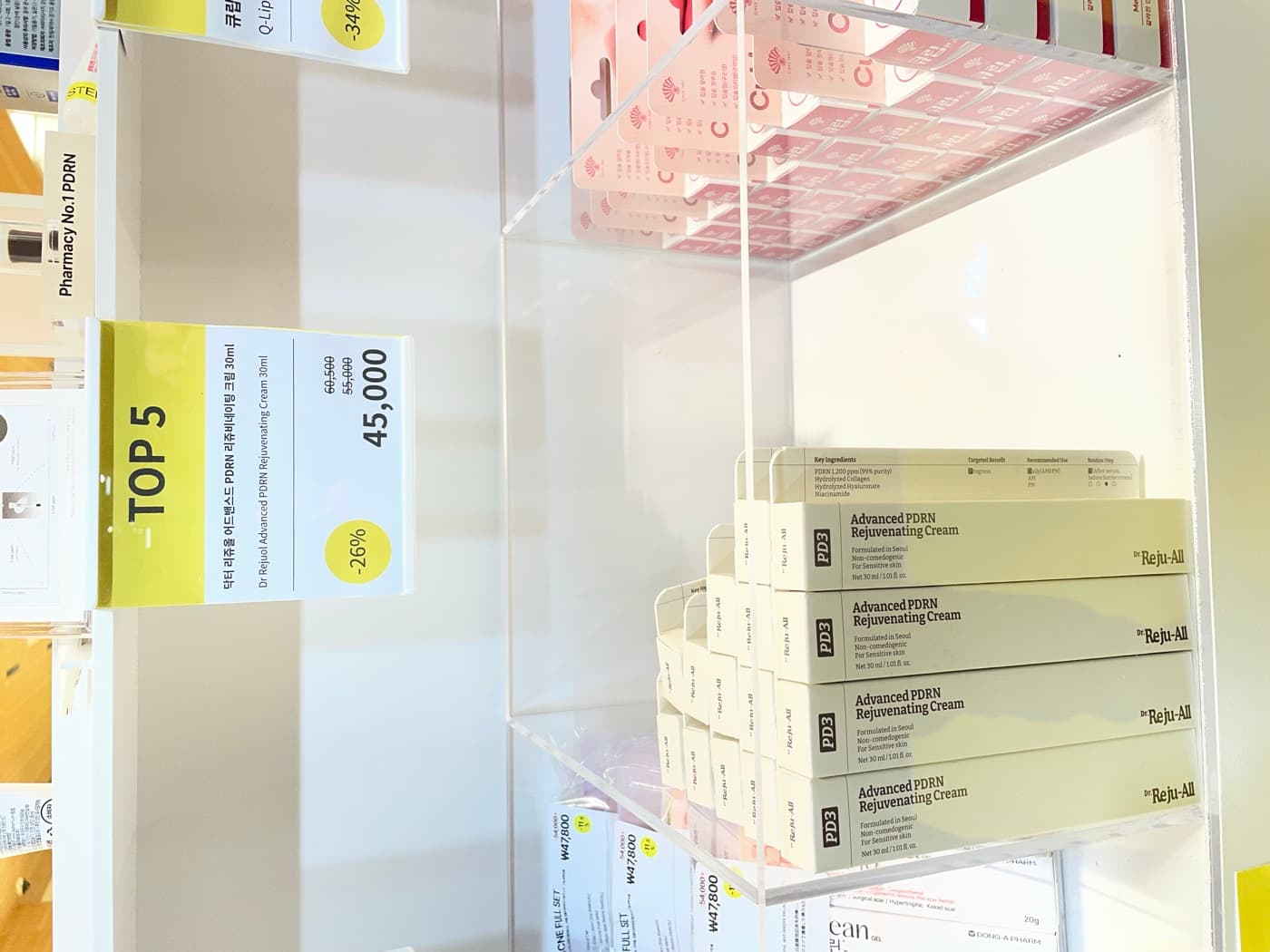
If your mental image of PDRN is a little glass serum bottle from Olive Young, I have news for you. PDRN has officially escaped the serum aisle.
I spent an afternoon in one of those tourist-facing Korean pharmacies — the kind with English signs in the window and a "Pharmacy No.1 PDRN" tower by the door — and the salmon-DNA situation has gotten genuinely wild. PDRN eye drops. PDRN you drink. Pharmacy-grade PDRN lip serum on a little lit-up tester stand. None of which you'll find next to the snail mucin at your usual store.
So this is a field report. What these products actually are, who makes them, and — because some of them go in your eyes and your mouth — what you should actually know before handing over your card.
If you want the regular PDRN serums and creams ranked, I already did that in 9 Best PDRN Products. This post is about the weird and wonderful stuff one shelf over.
Quick refresher: what even is PDRN?
PDRN is polydeoxyribonucleotide — short fragments of DNA, usually extracted from salmon sperm or roe (yes, really). The fragments are similar enough to human DNA that they're thought to support tissue repair and a process called fibroblast stimulation, which is the cell activity behind collagen. It first got famous as Rejuran, the injectable "skin booster" dermatologists use, and the strongest science behind PDRN is honestly in that injectable and wound-healing world. The topical and ingestible versions are newer and the evidence is still catching up — keep that in your back pocket as you read. I get deeper into the mechanism in my peptides and PDRN guide.
Now, the pharmacy haul.
Why a pharmacy, and why is it in English?
First, context, because this matters. These aren't your neighborhood Korean pharmacies — they're a whole new tourist phenomenon.
In Myeongdong alone there are now roughly 30 pharmacies catering specifically to foreign visitors, and about a dozen of them opened in just the last six months. Many have English-speaking pharmacists, and the products are tagged with plain-language labels in four languages — Korean, English, Chinese, and Japanese. Foreign spending at Korean pharmacies hit about ₩141.4 billion in 2025, up 142% year over year, and pharmacies now make up the majority of foreign "medical" spending in Korea. (KED Global, Creatrip)
The reason PDRN lives in the pharmacy and not just the beauty store is partly regulatory and partly marketing. Some of these formats — eye drops especially — are classified as medical or quasi-drug products that genuinely belong behind a pharmacy counter. And the "pharmacy-grade" framing is a selling point in itself: higher PDRN concentrations, clinical-looking packaging, and a pharmacist who'll explain it to you in English. That's the pitch.
Okay. The products.
1. The pharmacy hero cream: Dr. Reju-All Advanced PDRN Rejuvenating Cream
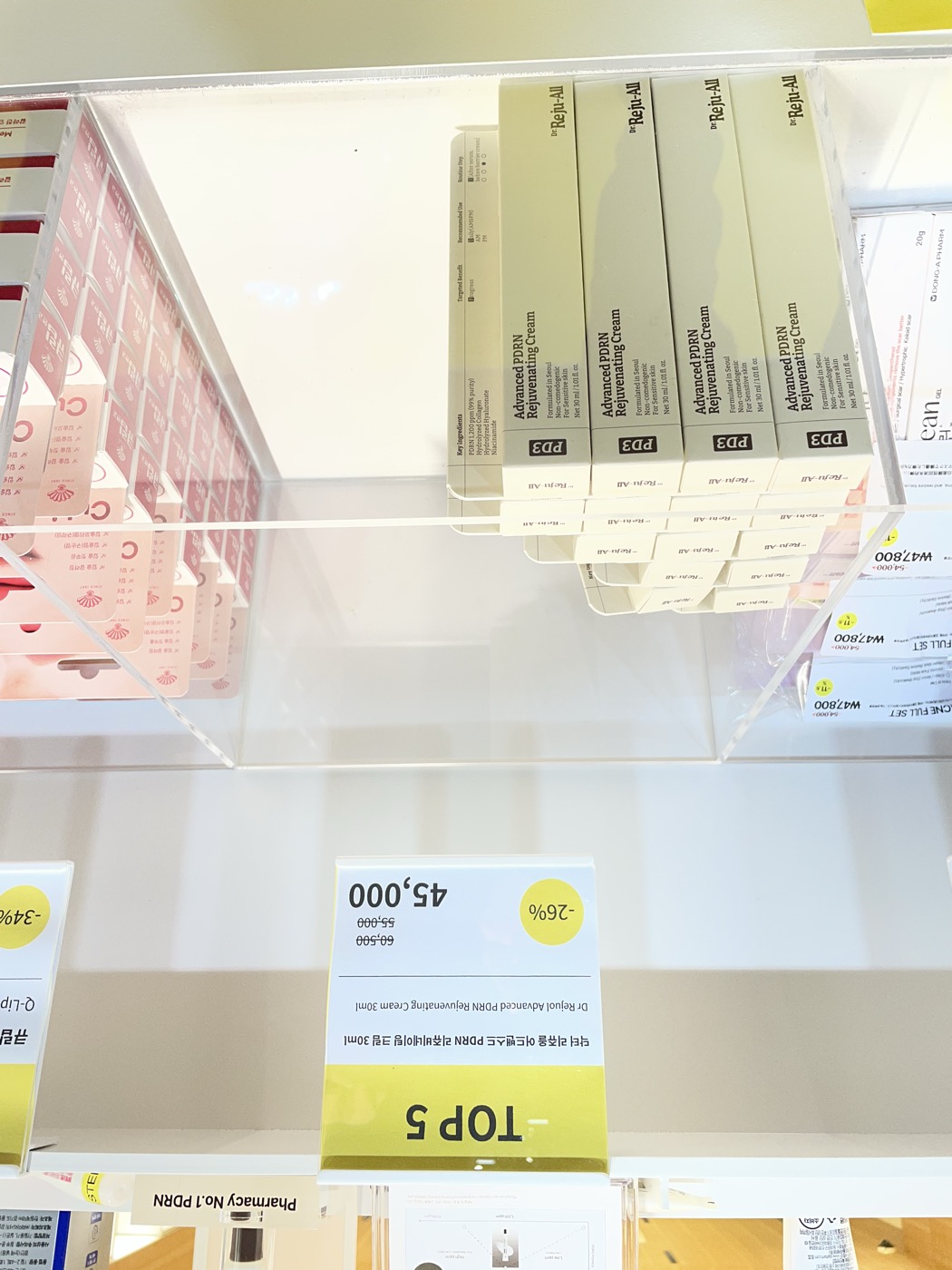
This is the one closest to "a normal cream," so let's start here. Dr. Reju-All brands itself as Korea's No.1 pharmacy skincare brand, founded by a team of pharmacists and doctors in Seoul, and it claims to have sold over a million units of this cream in six months across thousands of Korean pharmacies. (Dr.Reju-All)
The shelf card here listed it at ₩45,000 (about $33), marked down from ₩60,500. The spec sheet on the box is the interesting part: PDRN at 1,200 ppm, 99% purity, plus hydrolyzed collagen, hydrolyzed hyaluronate, and niacinamide. "Formulated in Seoul, non-comedogenic, for sensitive skin." It's a gel-cream that's meant to go on after your serum, before a barrier cream.
Honestly this is the least surprising item — it's a well-formulated PDRN moisturizer, and I ranked the Max version of it in my main PDRN roundup. It earns its spot here mostly because seeing "1,200 ppm / 99% purity" printed on the box like a nutrition label is very pharmacy-core, and it's the gateway product the staff steer most tourists toward.
2. The genuinely surprising one: Re-an PDRN Eye Drops
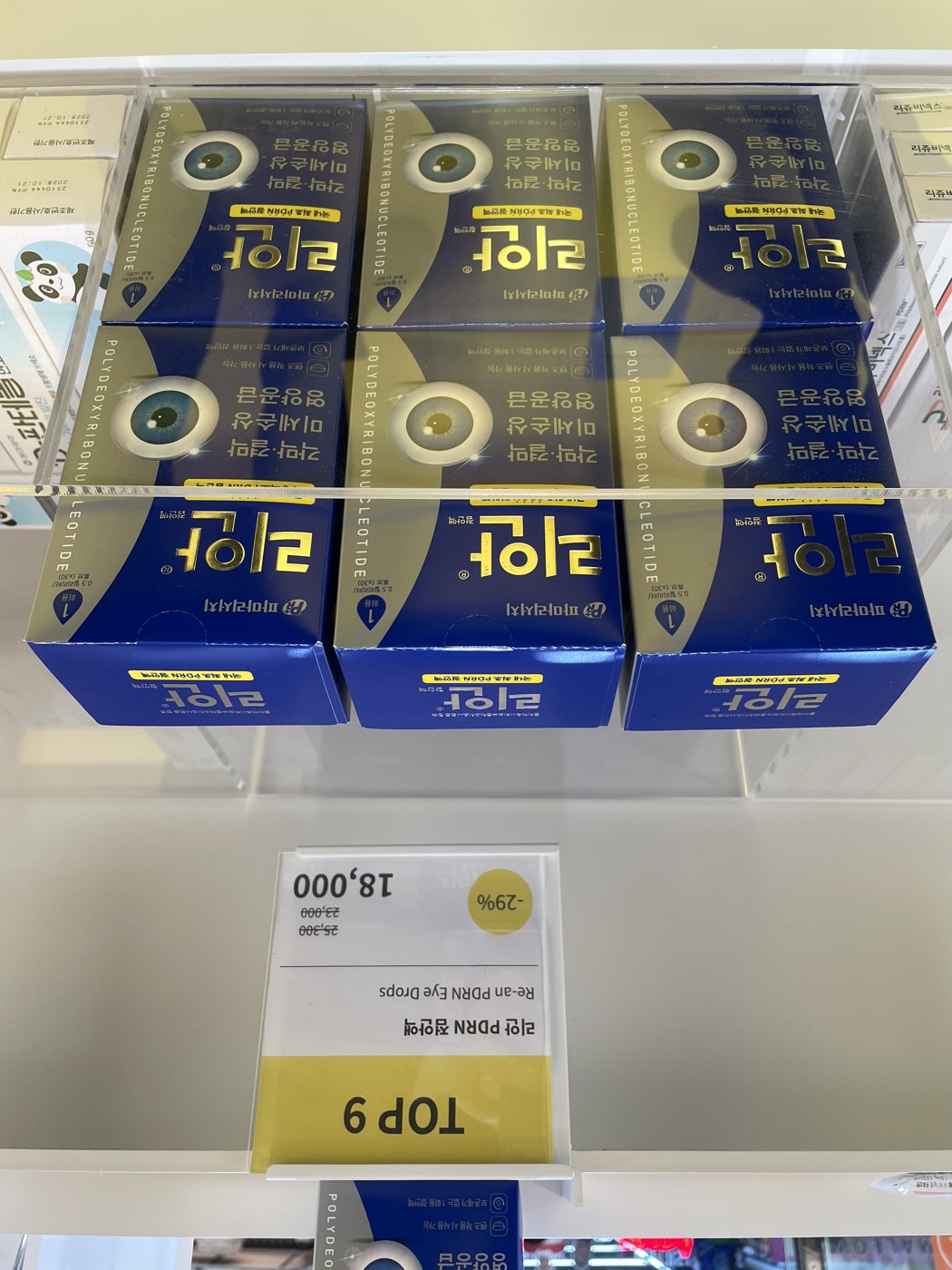
This is the one that stopped me. PDRN eye drops.
Re-an (리안) is made by PharmaResearch (파마리서치) — and that name should ring a bell, because they're the company behind Rejuran, the famous PDRN injectable. PharmaResearch has been working with salmon-derived PDRN since they started their own R&D in 2011, across wound-healing products, joint injections, and now this. The box is marketed as Korea's first PDRN eye drops (국내 최초), aimed at micro-damage to the cornea and conjunctiva, and it's the kind you can use even with contact lenses in. Single-use sticks, 0.5 ml × 30. (PharmaResearch via sthkbeauty)
The shelf price was ₩18,000 (about $13), down from ₩25,300.
Here's where I put on my responsible-adult hat. This is a medical eye product, not a beauty treat. The PDRN-for-corneal-repair idea comes from real clinical research on the eye surface — but that means it's a product for actual eye dryness and irritation, prescribed-adjacent, not a skincare flex to add to your shelfie. If you have a genuine eye problem, see an eye doctor. If you're curious and just want lubricating drops, talk to the (English-speaking) pharmacist about whether it's appropriate for you, and follow the directions on the box. Don't buy it because it has the same buzzword as your serum.
3. The "inner beauty" one: RE4DAY drinkable PDRN
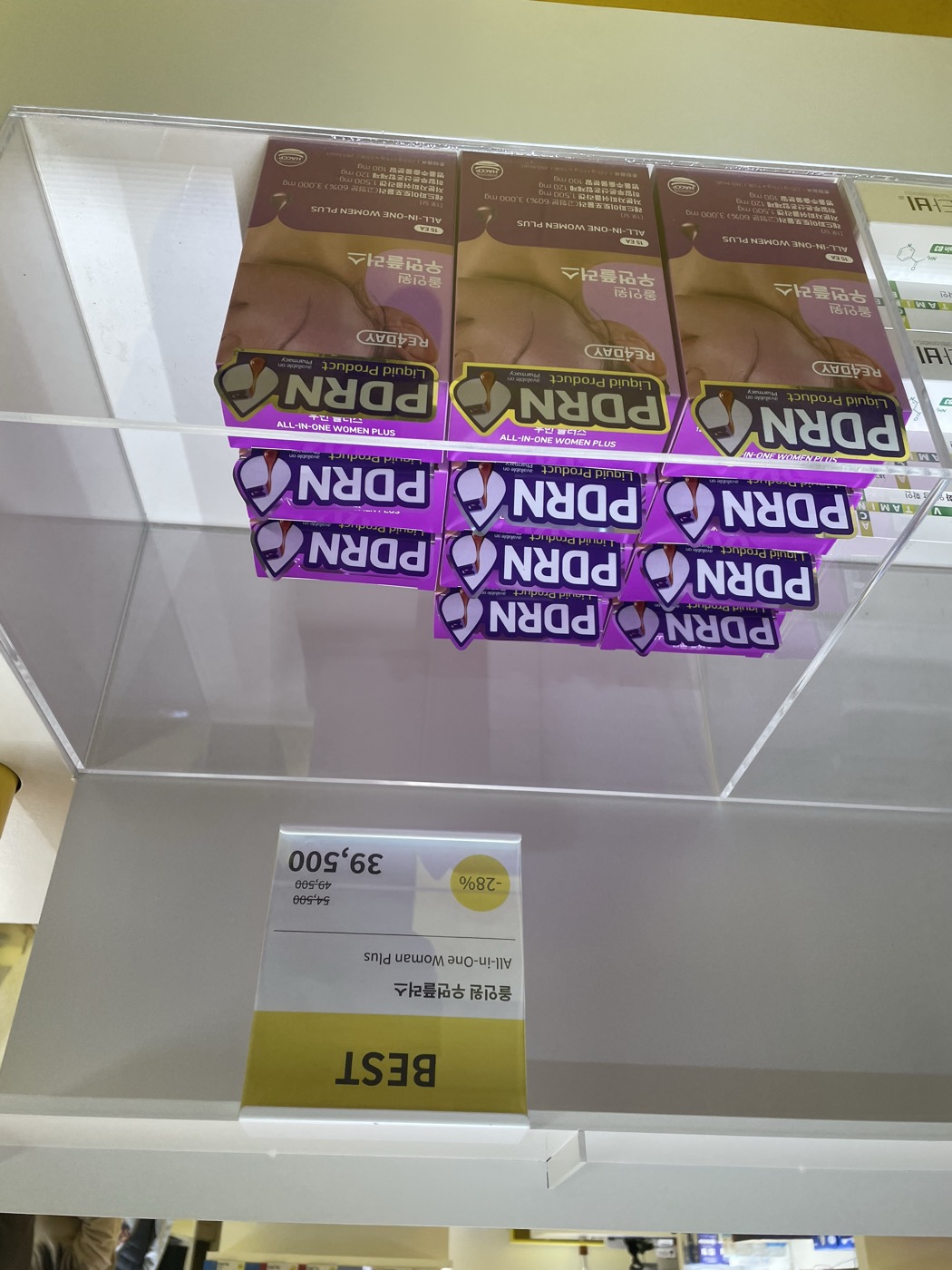
PDRN you drink. Welcome to "inner beauty," one of the biggest-growing categories in Korean skincare right now — the idea that you support your skin from the inside with supplements rather than only topping it with serums.
RE4DAY (stylized RE:DAY) All-in-One Woman Plus is a liquid sachet you sip once a day. It pairs PDRN with fish collagen (it lists 60% collagen at 3,000 mg), elastin, hyaluronic acid, and a few extras, and carries Korea's HACCP food-safety mark. (RE4DAY via Amazon) The shelf card called it a BEST seller at ₩39,500 (about $29), down from ₩54,500.
Expectation management, because I love you: the meaningful, well-studied ingredient in a drink like this is the collagen — there's a reasonable body of research on hydrolyzed collagen peptides and skin hydration/elasticity. The oral PDRN part is the trendy headline, and its skin benefits when you drink it are far less established than PDRN that's injected or applied. So think of this as a perfectly nice collagen supplement wearing a PDRN hat. If you already take a collagen drink and like the ritual, fine. If you're expecting it to do what a Rejuran appointment does, it won't.
4. The cute one: Dr. Reju-All PDRN Lip Serum
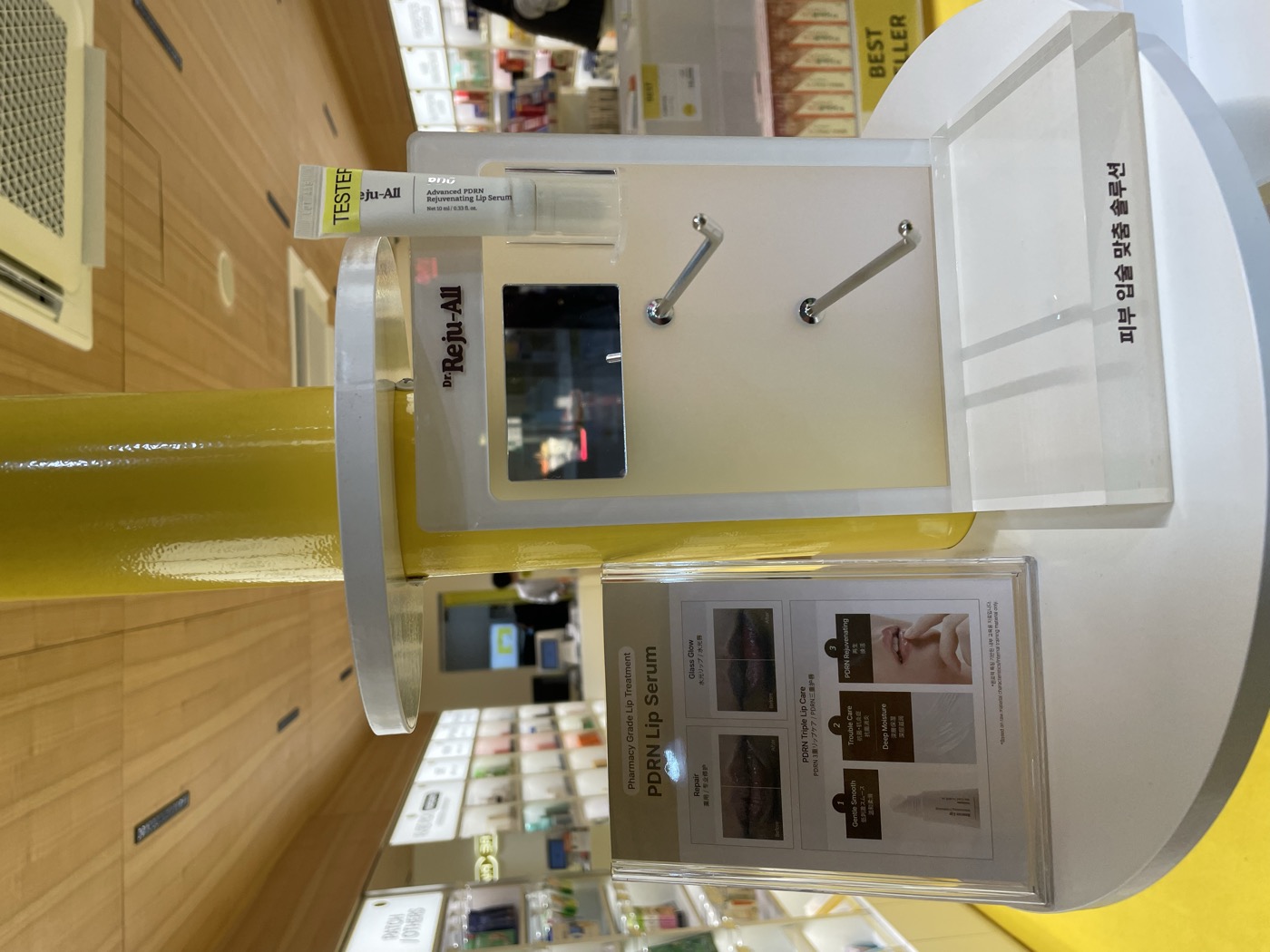
Back to safer, more fun territory. Dr. Reju-All also makes an Advanced PDRN Rejuvenating Lip Serum (10 ml), and it got the full treatment — its own lit-up tester stand with a touchscreen, which is how you know a Korean pharmacy considers something a hero product.
The card pitches it as "pharmacy-grade lip treatment" with PDRN Triple Lip Care: a gentle-smoothing step, a deep-moisture/trouble-care step, and a PDRN "rejuvenating" step, all promising the now-mandatory "glass glow" finish. It's basically a treatment lip serum that borrows the brand's hero ingredient. Low stakes, genuinely nice for dry lips, and a much more sensible impulse buy than, say, eye drops you don't need.
So what's actually worth it?
Quick honest sorting, tourist to tourist:
- The cream — solid, real, a good buy if you want a pharmacy-grade PDRN moisturizer and don't already own a PDRN cream. Compare against my ranked picks first.
- The lip serum — a fun, low-risk grab. Treatment lip care is having a moment and this is a pleasant version of it.
- The drink — fine as a collagen supplement if you enjoy the ritual. Don't pay the "PDRN" premium expecting magic; manage expectations.
- The eye drops — the most fascinating, the most "only in a Korean pharmacy," and the one to be most careful with. It's a medical product. Ask the pharmacist, don't self-prescribe, and see an actual eye doctor for actual eye problems.
A few practical notes for the pharmacy itself
If you're heading to one of these tourist pharmacies (Myeongdong, Hongdae, Dongdaemun all have them):
- The staff speak English and the shelf labels are usually in four languages. Use that — ask what the PDRN concentration is and whether something is a cosmetic or a medical product. They'll tell you.
- Prices are negotiable-ish via bundles, not haggling. Those TOP 5 / BEST signs are loss-leaders to pull you in; the real deals are the "full set" bundles.
- Tax-free shopping applies for tourists over the spending threshold — bring your passport.
- Be skeptical of the ranking cards. "TOP 5" means "we'd like you to buy this," not "clinically proven #5." Read the actual ingredient panel, which on these pharmacy boxes is refreshingly detailed.
The big picture: PDRN started as a derm-office injectable, became a serum, and is now busy colonizing every product format Korea can think of — eyes, mouth, gut, lips. Some of that is real innovation (the eye drops come from a serious company doing serious research). Some of it is a buzzword getting stapled onto a collagen drink. Knowing which is which is the whole game — and now you do.
Curious whether PDRN even belongs in your routine, or whether you'd get more from a peptide or a barrier cream? Take our skin quiz and we'll match you to what your skin actually needs — not whatever's on the TOP 5 sign.
Product prices and availability are accurate as of the date/time indicated and are subject to change. Any price and availability information displayed on Amazon at the time of purchase will apply to the purchase of this product.
Medical disclaimer. This article is for educational purposes and is not medical advice. Everyone’s skin is different, and what works for one person may not work for another. If you have persistent or painful skin concerns, please see a licensed dermatologist or healthcare professional.