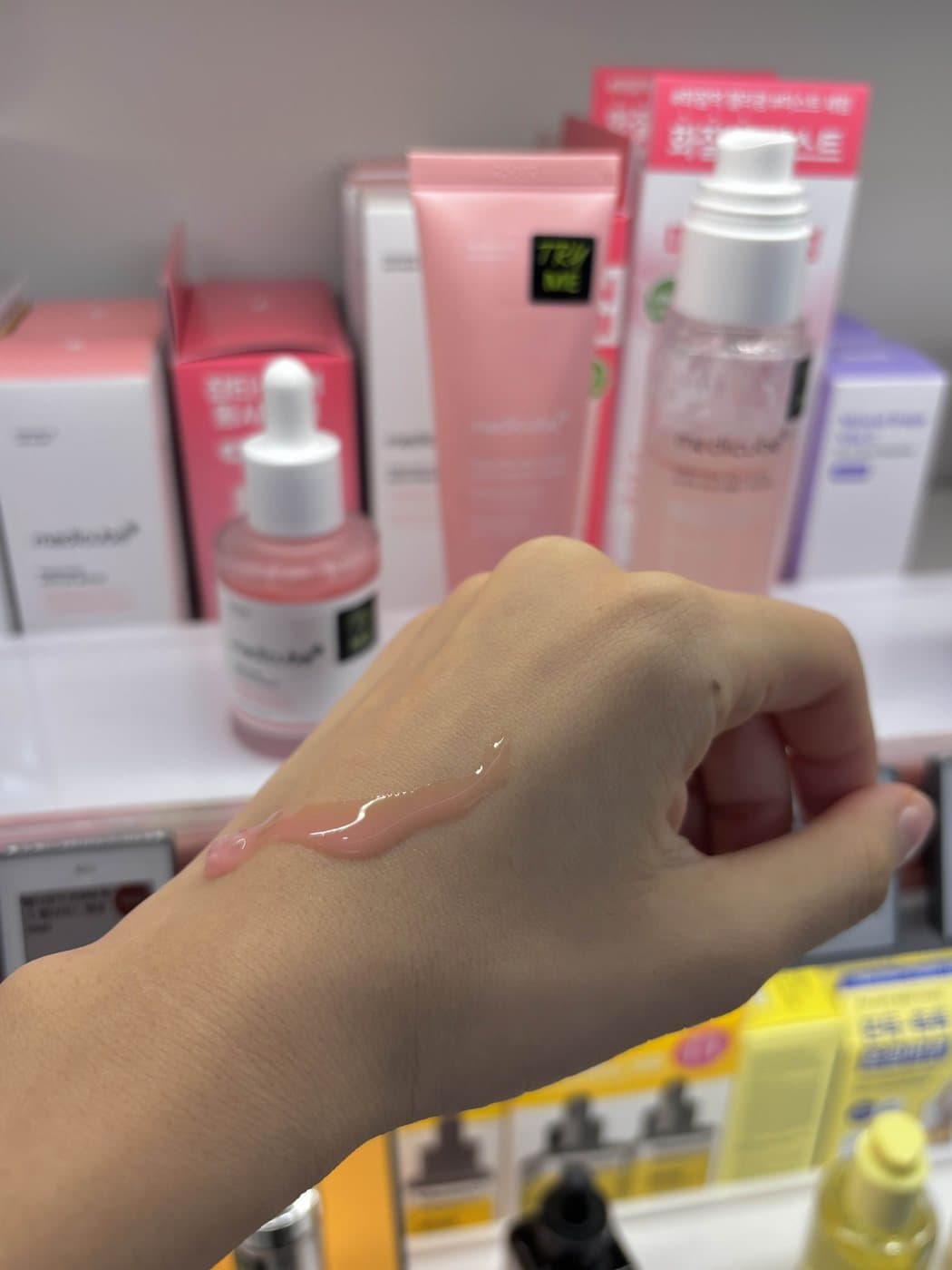
There is a whole wall of PDRN at Olive Young now. Serums, toner pads, eye creams, mists. Lots of pink packaging, lots of the word "salmon," and remarkably little on any of the boxes about what PDRN actually is.
So here's the version we wanted when we first stood in that aisle.
The Short Answer
- PDRN is purified DNA. The name is short for polydeoxyribonucleotide, and the pharmaceutical version comes from salmon sperm.
- Its track record is as a drug, not a cosmetic. The research behind it is mostly injections and wound care.
- PN is its bigger sibling. Polynucleotides are longer DNA chains, used as injectables for a different job.
- Getting it into skin from a serum is the open question. Pharmaceutical-grade PDRN is hundreds of times larger than what normally passes the skin's outer layer, and most brands don't say how large theirs is. The best clinical evidence we found is two small eye-cream trials from the same research group, only one of which we could read in full. Encouraging, but thin.
- So: a PDRN serum can be a perfectly good serum. It is not an injection in a bottle, and any product implying otherwise is overselling.
If you've already decided to buy one, our PDRN comparison is where the picks are. This page is about what you're actually paying for.
So what is it, exactly?
DNA, broken into fragments and purified.
The version with a real pharmacology literature behind it is described in a 2017 review in Frontiers in Pharmacology. It's a mixture of DNA fragments with molecular weights between 50 and 1,500 kilodaltons, taken from the sperm DNA of salmon trout (Oncorhynchus mykiss) or chum salmon (Oncorhynchus keta).
Yes, that's where the "salmon sperm facial" headlines come from. Nobody is putting fish on your face. What ends up in the bottle is a purified, water-soluble DNA salt.
On a cosmetic ingredient list you usually won't see the word PDRN at all. You'll see Sodium DNA, which the EU's cosmetic ingredient database, CosIng, defines simply as "deoxyribonucleic acid, sodium salts." Some brands use Hydrolyzed DNA instead. Keep that in your back pocket, because it matters later.
Why clinics use it
The same 2017 review describes how PDRN is thought to work. It acts on a receptor on cells called the adenosine A2A receptor, which is involved in dialling down inflammation and supporting tissue repair. And it supplies building blocks that cells can recycle to make new DNA (the "salvage pathway").
In medicine, that's been put to work on slow-healing wounds. The review describes a diabetic foot ulcer trial in which PDRN was given by intramuscular injection and injected around the wound. It also mentions uses as eye drops and topical gels.
Aesthetic medicine picked it up from there. A 2026 narrative review in Cureus says PDRN is most often injected into the skin, and looks at whether it could be added to recovery after procedures like laser resurfacing, chemical peels and microneedling. It also notes that no published human randomised trial has tested it that way yet. Still, the clinic reputation is a big part of why the ingredient has such a halo on the shelves.
Hold onto the detail that matters: the strongest evidence is for PDRN delivered below the skin surface.
PDRN vs PN: the name confusion
You'll see "PN" or "polynucleotides" used almost interchangeably with PDRN, especially in clinic marketing. They're related but not the same thing.
A 2025 review in Biomolecules tried to pin the terms down with a proposed cutoff at 1,500 kilodaltons: shorter and medium-length chains below it are PDRN, longer chains at or above it are PN.
The length changes the job. A 2025 comparison in Pharmaceutics describes PN as forming a "porous, highly viscous, three-dimensional structure" involved in remodelling the skin's supporting matrix, while PDRN's effects are mostly put down to that receptor signalling. PN is the one widely used as an injectable "skin booster." In a survey of 235 Korean dermatologists published in 2024, 88% said they used PN injections.
That's also why one brand name turns up in both places. Rejuran is best known as a clinic injectable — the Cureus review notes its wide use in the Asian aesthetic market — and the same name is on serums at Olive Young. Same name, different products.
For skincare shopping, the practical takeaway is modest: if a product says PN, it's describing longer chains, and longer chains have an even harder time getting into skin. The Biomolecules review notes, while describing how some DNA ingredients are processed, that long polymer chains cannot be absorbed into the skin.
Can a serum actually get PDRN into your skin?
This is the part the marketing skips.
Dermatology has a long-standing rule of thumb, set out by Bos and Meinardi in 2000: molecules generally need to be under about 500 daltons to get through the skin's outer layer. That's a guideline, not a law of physics, but it's widely used.
Now the arithmetic. The 2017 Frontiers review puts the most common PDRN fragment size at 80–200 kilodaltons, peaking around 132. A kilodalton is 1,000 daltons. So a typical PDRN fragment is in the region of 260 times that threshold.
That's pharmaceutical-grade PDRN. Cosmetic PDRN can be smaller — the Biomolecules review mentions low-molecular-weight versions made specifically to get into skin, and some brands advertise "low molecular weight" PDRN — but brands rarely publish the actual size. Either way, it doesn't mean nothing happens. It does mean you shouldn't assume a serum behaves like the injection.
The clinical studies we found
We looked for controlled human trials of topical PDRN on skin ageing. The two worth describing both tested eye creams, and both come from the same research group.
The larger write-up is a 2026 study in PLOS One:
- 31 Chinese women aged 35 to 55, all with self-reported sensitive skin.
- Split-face and double-blind. Each woman used a PDRN eye cream around one eye and a retinol eye cream around the other for four weeks, with daily sunscreen required throughout.
- Both creams were 0.1%. The PDRN was a medium-length preparation the researchers call PDRN-850K.
- The researchers reported roughly twice the improvement in wrinkles around the eye on the PDRN side, and lab tests suggesting the PDRN reached the living layers of the epidermis.
- The authors declared no conflicts of interest. Three of the five authors list affiliations with biotechnology companies, which is common in this field and worth knowing.
An earlier paper from the same group, published in 2025, reports a placebo-controlled eye-cream trial in 33 women. The PLOS One authors cite it as their previous work. We couldn't access that paper to check its details, so we're not repeating its results here.
That's genuinely interesting. It's also two small, short trials from one group, of specific preparations, neither of them a product you'll find named on a shelf. They don't tell you what the PDRN in your serum does, at whatever concentration and fragment length the brand chose.
What this means when you're shopping
A few things follow from all of the above, and they're more useful than any single product pick.
Judge a PDRN serum as a serum. Every PDRN product whose official ingredient list we checked for this guide also contains better-established ingredients — niacinamide, peptides, hyaluronic acid, ceramides, sometimes retinol. Those are doing plenty of the work you'll notice.
"99%" on the box probably isn't quantity. Medicube's toner pad jar reads "High Purity Salmon PDRN 99%." Medicube doesn't say what the 99% measures, but next to "High Purity" it reads as the purity of the raw ingredient. On the official ingredient list, Sodium DNA sits 44th of 58. We break this down, with photos, in our guide to PDRN toner pads and eye creams.
An ingredient list can't tell you if the DNA came from a salmon. "Sodium DNA" describes the chemical, not the animal or plant it came from. So "vegan PDRN" and "salmon PDRN" can look identical on the back of the box. We compared what brands claim against what their labels show in salmon DNA vs vegan PDRN.
Anyone promising injection results from a bottle is selling you something. Retinol — the benchmark in the PLOS One trial — has a far longer research record for wrinkles. If ageing skin is the reason you're here, our PDRN guide for mature skin is built around that.
FAQ
Is PDRN actually from salmon sperm? The pharmaceutical-grade PDRN described in most of the research is extracted from salmon sperm DNA. Many skincare brands say theirs is salmon-derived too. Others sell plant- or probiotic-based versions under the same name, and those are not the same material.
Is PDRN the same as PN? No. Both are DNA fragments, but PN refers to longer chains. A proposed scientific cutoff puts the line at 1,500 kilodaltons.
Does topical PDRN work? The best evidence we found comes from one research group: a small randomised eye-cream trial against retinol that reported wrinkle improvements over four weeks, and an earlier placebo-controlled trial we couldn't access in full. That's promising but thin, and neither tested a product you can identify on a shelf.
Is PDRN safe in skincare? It's widely sold in Korean cosmetics and generally marketed as gentle. If you avoid fish-derived ingredients for any reason, check the brand's stated source, because the ingredient list won't show it. As with anything new, patch test first, and speak to a dermatologist if you have a skin condition.
Is a PDRN serum a substitute for a PDRN injection? No. The clinic treatment delivers it below the surface. A serum doesn't, and the evidence for the two is very different.
Sources
- Squadrito F, et al. Pharmacological Activity and Clinical Use of PDRN. Frontiers in Pharmacology, 2017.
- Marques C, et al. From Polydeoxyribonucleotides (PDRNs) to Polynucleotides (PNs). Biomolecules, 2025; 15(1):148.
- Kim ST. Comparison of Polynucleotide and Polydeoxyribonucleotide in Dermatology. Pharmaceutics, 2025; 17(8):1024.
- Flores Rodríguez JC, et al. Polydeoxyribonucleotide (PDRN) in Post-procedure Recovery in Aesthetic Medicine: A Narrative Review. Cureus, 2026; 18(5):e108886.
- Bos JD, Meinardi MM. The 500 Dalton rule for the skin penetration of chemical compounds and drugs. Experimental Dermatology, 2000; 9(3):165–9.
- Ye R, et al. Topical medium-length PDRN enhances dermal extracellular matrix repair in photodamaged skin via PI3K–Akt/TGF-β–regulated pathways. PLOS One, 2026.
- Liu S, Wang Q, Wang M, Yan C, Ye R, Du L, Hu F. Multi-Pathway Fibroblast Modulation by PDRN Restores Dermal Structure and Improves Periocular Aging. Journal of Cosmetics, Dermatological Sciences and Applications, 2025; 15(4):159–176.
- Rho NK, et al. A survey on the cosmetic use of injectable polynucleotide: the pattern of practice among Korean dermatologists. Journal of Cosmetic Dermatology, 2024.
- European Commission. CosIng: Sodium DNA.
- Medicube. PDRN Pink Collagen Gel Toner Pad — official product page and ingredient list.
Prices and availability are accurate as of the date this post was last updated and are subject to change. The price shown on Amazon at the time of purchase is the one that applies.
Medical disclaimer. This article is for educational purposes and is not medical advice. Everyone’s skin is different, and what works for one person may not work for another. If you have persistent or painful skin concerns, please see a licensed dermatologist or healthcare professional.